
Funding the Future
Navigating BEAD and Private Capital for Broadband Growth


The independent broadband operator’s path to sustainable growth has never been more clearly illuminated—or more complex to navigate. With $42.45 billion in federal BEAD funding flowing to states and private capital increasingly focused on telecommunications infrastructure, the financial landscape for network expansion has fundamentally transformed. Yet access to capital, whether public or private, is only half the equation. The real challenge lies in deploying that capital efficiently while maintaining the operational excellence and community focus that differentiate independent operators.
Having worked with operators across diverse funding environments—from venture-backed urban overbuilders to cooperative rural providers accessing USDA programs—I’ve learned that successful capital deployment requires more than just winning grants or attracting investors. It demands strategic planning, operational discipline, and the ability to manage multiple stakeholder expectations while staying true to the community-focused mission that makes independent operators competitive.
The BEAD Opportunity: Unprecedented Scale, Complex Reality
The Broadband Equity, Access, and Deployment program represents the largest federal investment in broadband infrastructure in American history. For independent operators serving rural and underserved communities, BEAD funding could be transformational—providing the capital necessary to build fiber networks that would otherwise require decades to self-finance through operations.
However, BEAD funding comes with complexities that can overwhelm operators unprepared for the administrative and operational burdens. Application processes vary by state, requiring detailed technical submissions, financial documentation, and long-term operational commitments. Build requirements often mandate fiber-to-the-premises architectures that, while technically superior, carry higher per-passing costs than hybrid or wireless alternatives. Most critically, BEAD awards typically require operators to complete builds within aggressive timelines while meeting rigorous reporting and compliance obligations.
As of early 2025, BEAD implementation varies dramatically by state. Some states have already announced initial awards and begun project approvals, while others are still finalizing their processes. This uneven rollout creates both opportunities and challenges. Operators in early-implementing states face compressed timelines and intense competition for limited construction resources. Those in slower-moving states have more time to prepare but risk seeing private capital and construction partners committed elsewhere.
The operators who succeed with BEAD funding won’t be those who simply qualify for the largest awards—they’ll be those who can execute efficiently, manage compliance rigorously, and deploy capital in ways that build sustainable long-term operations rather than just completing grant obligations.
Beyond BEAD: The Private Capital Revolution

While BEAD dominates broadband funding discussions, a parallel transformation is occurring in private capital markets. Infrastructure investment funds, private equity firms, and even family offices are increasingly viewing independent broadband operators as attractive investments. This attention reflects several converging trends: recognition of broadband as essential infrastructure with predictable cash flows, growing consumer dissatisfaction with incumbent service quality, and the defensive moats that community-focused operators can build in their service areas.
Private equity and venture capital investments in telecommunications services totaled $5.04 billion in Q3 2024 alone, with significant portions flowing to small and mid-sized broadband providers. This capital comes in various forms—debt financing for network construction, equity investments for expansion, and structured partnerships that provide both capital and operational expertise. Unlike BEAD funding with its prescriptive requirements, private capital offers flexibility in deployment but brings different obligations: investor returns, growth expectations, and eventual liquidity events.
The most sophisticated independent operators are learning to blend public and private capital strategically. BEAD funding can finance builds in economically challenging areas where private capital might hesitate. Private investment can accelerate expansion in higher-density markets where BEAD eligibility is limited. Together, these funding sources enable network footprints and service offerings that neither could support independently.
Financial Structuring for Sustainable Growth
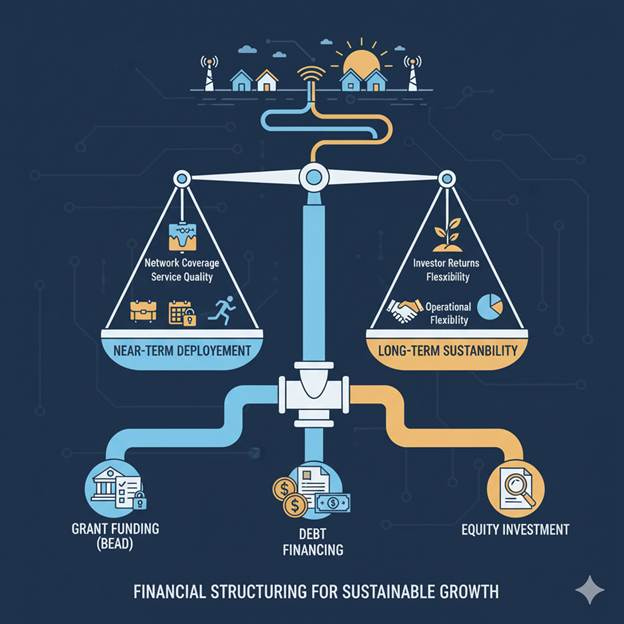
The availability of capital—whether federal grants or private investment—doesn’t guarantee success. Independent operators must structure their finances to support both near-term deployment and long-term sustainability. This requires balancing multiple, sometimes competing objectives: maximizing network coverage, maintaining service quality, generating sufficient returns to attract continued investment, and preserving the operational flexibility that enables competitive differentiation.
Debt financing, historically the primary capital source for telecommunications infrastructure, offers predictable costs and maintains operator control but requires sufficient cash flow to service obligations. Equity investment provides greater capital flexibility and aligns investor interests with long-term value creation but dilutes ownership and may introduce external governance requirements. Grant funding minimizes capital costs but comes with compliance burdens and deployment mandates that may not align with optimal market expansion strategies.
Strategic Capital Deployment:A mid-sized operator in the Southeast provides an instructive example of integrated funding strategy. By securing a $15 million BEAD award for rural expansion while simultaneously raising $8 million in equity from a regional infrastructure fund, they created a capital structure that leveraged public funding for challenging builds while using private capital for adjacent market expansion and operational infrastructure. The BEAD award required fiber deployment to 2,500 rural locations within 30 months—a timeline made feasible by using equity capital to pre-purchase materials, establish strategic contractor partnerships, and build administrative systems before BEAD deployment began. This advance preparation reduced construction timelines and enabled them to meet aggressive federal requirements while positioning for profitable expansion beyond BEAD-funded areas.
The key to financial sustainability lies in maintaining discipline about capital deployment efficiency. Every dollar of capital, regardless of source, should generate multiple returns: immediate network capability, future expansion optionality, and operational learning that improves subsequent deployment efficiency. This disciplined approach becomes even more critical when managing multiple capital sources with different timing requirements and performance expectations.
The Construction Partner Multiplier Effect

As we explored in the previous article on operational excellence, contractor selection represents one of the most critical factors in capital efficiency. This becomes even more pronounced when deploying large amounts of capital under tight timelines—exactly the situation BEAD funding creates. Operators who engage proven mid-size contractors rather than large turnkey providers can often reduce per-passing construction costs by 15-25% while maintaining better schedule control and quality outcomes.
These cost savings compound across large deployments. A $10 million BEAD build that costs 20% less through strategic contractor partnerships generates $2 million in savings that can fund approximately 200 additional passings in typical rural deployments. Over multiple projects, these efficiencies can mean the difference between sustainable operations and perpetual capital scarcity.
Private capital providers increasingly recognize this dynamic. Sophisticated infrastructure investors evaluate not just network plans and market opportunities but also operator capabilities in managing construction partners and deploying capital efficiently. Operators with demonstrated track records of cost-effective deployment and strong contractor relationships find it easier to attract favorable capital terms.
Navigating the BEAD Application Maze
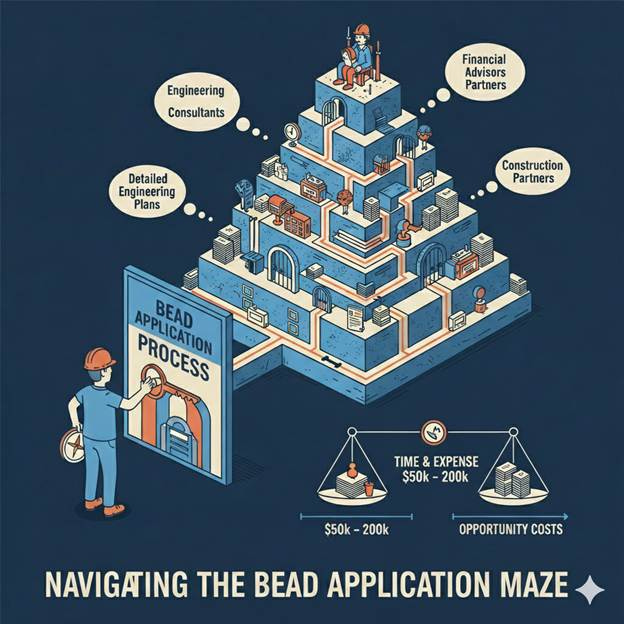
For many independent operators, the BEAD application process represents their first engagement with federal grant programs of this scale and complexity. While specific requirements vary by state, common elements include detailed network engineering plans, financial capability demonstrations, operational readiness certifications, and long-term sustainability commitments. The administrative burden of preparing competitive applications should not be underestimated.
Successful applicants typically begin preparation months before application windows open. This includes engaging engineering consultants to develop compliant network designs, working with financial advisors to structure capital plans that demonstrate sustainability, and building relationships with construction partners who can provide realistic cost estimates and capacity commitments. Operators who treat BEAD applications as strategic planning exercises rather than bureaucratic obligations often find the process clarifies their growth strategies and strengthens their operations beyond just securing funding.
However, operators should also be realistic about opportunity costs. The time and expense required to prepare competitive BEAD applications—often $50,000 to $200,000 depending on project scale and available in-house expertise—represents significant investment for independent operators. Those who evaluate potential BEAD awards against alternative uses of both capital and management attention can make more strategic decisions about where to focus their growth efforts.
The Private Capital Pitch: What Investors Want to Hear

Attracting private capital requires a fundamentally different approach than securing federal grants. While BEAD applications emphasize service to underserved areas and compliance with federal requirements, private investors focus on returns, competitive positioning, and management capabilities. Independent operators must learn to articulate their value proposition in terms that resonate with capital markets.
The most compelling pitch to private investors combines three elements: defensible competitive advantages rooted in community connection and superior service, demonstrated operational efficiency in network deployment and customer acquisition, and credible growth opportunities that can generate attractive returns. Operators who can quantify their advantages—showing higher customer satisfaction scores, lower churn rates, and better unit economics than regional incumbents—create investment cases that speak directly to what capital providers value.
Management quality becomes particularly important in private capital evaluations. Investors want to back teams who understand both the technical and business aspects of broadband operations, who have demonstrated ability to execute complex projects under constrained resources, and who can articulate clear strategic visions while remaining pragmatic about implementation challenges. For independent operators, this often means building advisory boards or bringing in experienced industry executives who can complement founder expertise with specialized capabilities.
Blended Funding Strategies: Maximizing Financial Leverage
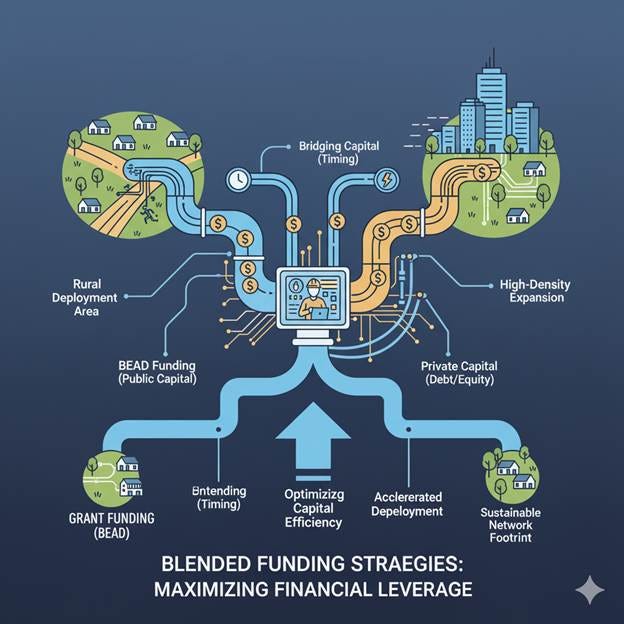
The most sophisticated independent operators are learning to use different capital sources strategically, matching funding types to specific deployment opportunities based on their characteristics and constraints. BEAD funding works best for rural areas where subscriber economics make private investment difficult to justify but where federal priorities support deployment. Private debt or equity capital often makes more sense for higher-density opportunities where returns can service capital costs and meet investor expectations.
This blended approach also creates timing advantages. BEAD awards typically flow to operators over multi-year deployment periods as milestones are achieved. Private capital can bridge timing gaps, enabling operators to start projects before grant funds arrive or to accelerate beyond minimum federal requirements when market opportunities justify faster deployment. The operators who master this capital choreography—knowing when to deploy which capital sources in what sequence—achieve deployment speeds and network footprints that any single funding source couldn’t support.
Independent operators should view capital not as a constraint to be overcome but as a strategic tool to be deployed thoughtfully. The goal isn’t maximizing total capital raised—it’s optimizing capital efficiency to build sustainable operations that can compete effectively while generating sufficient returns to support continued investment.
Risk Management: The Hidden Funding Challenge
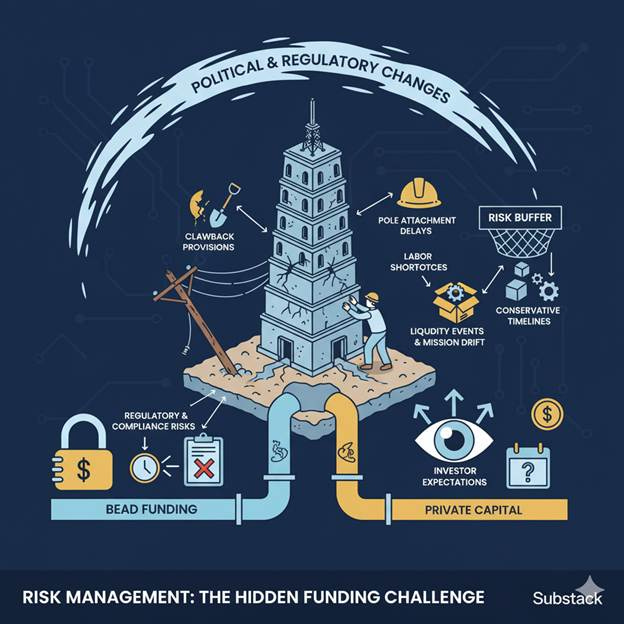
Both federal funding and private capital come with risks that operators must actively manage. BEAD awards carry clawback provisions that can force return of funds if deployment milestones aren’t met or compliance requirements are violated. Private capital brings investor expectations that may conflict with community-focused mission or create pressure for liquidity events that operators aren’t ready to execute.
The construction risks inherent in aggressive deployment timelines become more acute when managing multiple capital sources. Delays in securing pole attachment agreements, shortages of skilled construction labor, or supply chain disruptions for network equipment can cascade into missed BEAD milestones or investor performance expectations. Operators who build risk buffers into their plans—conservative timeline estimates, contingency budgets, backup contractor relationships—better weather the inevitable challenges that arise in complex infrastructure projects.
Regulatory and political risks also demand attention. BEAD program requirements continue to evolve as states implement federal guidelines, creating uncertainty about future compliance obligations. Changes in federal broadband policy with new administrations could affect program continuation or modify existing commitments. Private capital terms may include governance provisions that limit operator flexibility in responding to market or regulatory changes.
The International Perspective: Lessons from Abroad
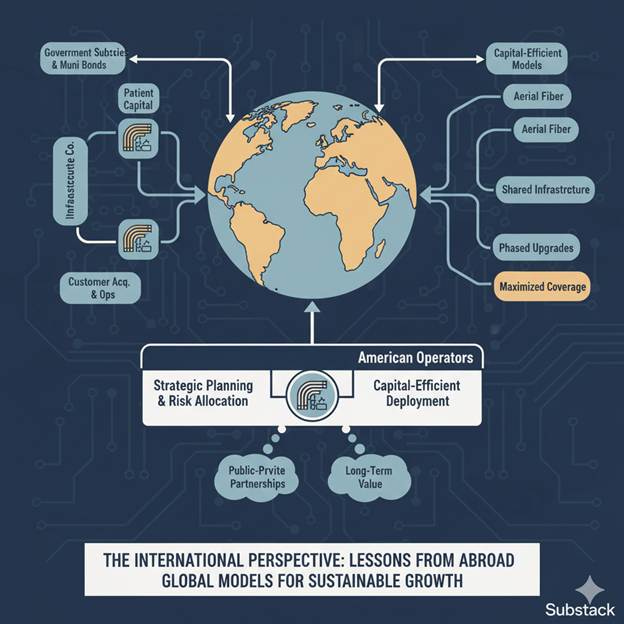
While American independent operators navigate BEAD and domestic capital markets, international broadband markets offer instructive lessons about funding models and deployment strategies. Many countries have successfully deployed fiber networks through public-private partnerships that blend government infrastructure investment with private operational expertise. These models provide frameworks for thinking about capital structure and risk allocation that may inform American operators’ strategic planning.
European markets, for example, have seen successful fiber deployments funded through combinations of government subsidies, municipal bonds, and private investment—often structured as separate infrastructure and service companies. This separation allows infrastructure entities to access patient capital focused on long-term asset value, while service providers focus on customer acquisition and operational efficiency. While regulatory differences limit direct applicability to American markets, the underlying principles about matching capital sources to specific roles and risk profiles remain relevant.
Emerging markets offer different lessons, particularly about capital-efficient deployment models that maximize network coverage with constrained resources. Technologies like aerial fiber deployment, shared infrastructure models, and phased upgrade paths that start with basic connectivity and improve over time demonstrate approaches that may benefit American operators in economically challenging markets.
Building for Long-Term Value, Not Just Short-Term Deployment

The availability of unprecedented capital creates temptations to prioritize rapid deployment over sustainable operations. Operators can chase maximum BEAD awards or largest private investment rounds without adequately considering whether they have operational capabilities to deploy that capital efficiently. The result can be overextended organizations that build extensive networks but struggle to operate them profitably.
Sustainable growth requires matching deployment pace to organizational capability development. This means building or acquiring operational expertise—in network monitoring, customer service, financial management, and regulatory compliance—at the same rate as physical infrastructure expansion. It means developing systematic approaches to network planning, construction management, and quality control that can scale across multiple concurrent projects. Most importantly, it means maintaining the community focus and service quality that differentiate independent operators even as organizational size and complexity increase.
Private investors increasingly recognize this dynamic. The most sophisticated capital providers don’t just evaluate network plans and market opportunities—they assess organizational readiness to execute at scale. Operators who can demonstrate operational excellence, even in smaller current deployments, position themselves as attractive investment targets because investors can have confidence that capital deployed will generate expected returns.
The Path Forward: Strategic Capital Deployment
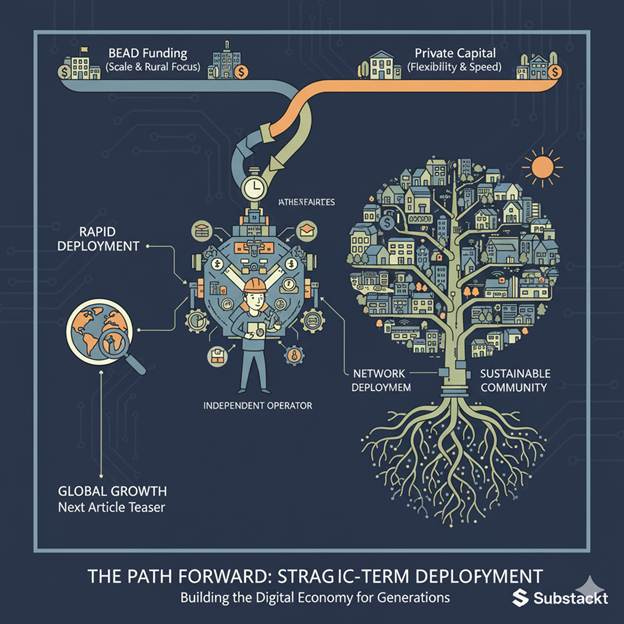
Independent broadband operators face an unprecedented opportunity to access capital for network deployment and growth. BEAD funding provides the scale to transform rural connectivity. Private capital offers flexibility and speed that government programs cannot match. Together, these funding sources can enable network footprints and service capabilities that seemed impossible just a few years ago.
Success requires more than just securing capital—it demands strategic thinking about how to deploy resources efficiently, maintain operational excellence at scale, and preserve the community focus that creates competitive differentiation. The operators who master this balance, who can navigate federal grant complexities while attracting private investment, who deploy capital with discipline while maintaining growth momentum, will build organizations that thrive long after current funding opportunities conclude.
The financial landscape for independent broadband operators has transformed. The question now isn’t whether capital is available—it’s whether operators can deploy it effectively to build sustainable competitive advantages. For those who can, the rewards extend far beyond financial returns. They’re building the infrastructure that will connect their communities to the digital economy for generations to come.
Looking Beyond Our Borders
In our next article, we’ll explore international broadband markets and examine how operators in other countries have successfully navigated funding challenges, regulatory frameworks, and competitive dynamics. These global perspectives offer valuable lessons for American independent operators as they chart their own paths to sustainable growth.
Stay tuned for insights from markets around the world and practical lessons that transcend borders.
Ready to Master the Capital Choreography?
The complexity of securing and blending billions in BEAD funding with demanding private capital requires more than planning—it demands proven executive experience.
At Fiber River, we don’t just consult on theory; we bring over 25 years of C-Level, real-life strategic leadership in the TMT vertical. We have extensive, hands-on experience guiding networks across the United States, Europe, and the Caribbean, ensuring every dollar of capital translates into sustainable growth and operational excellence.
If your organization is navigating the BEAD application maze, structuring a blended funding strategy, or optimizing construction partnerships, partner with seasoned TMT experts laser-focused on your success.
Don’t just secure the funding. Strategically deploy it.
Accelerate your infrastructure growth. Schedule a strategic consultation with Fiber River today.
Fiber River | Dedicated Strategic Leadership for Advanced Infrastructure Network Deployments